
The Bauhaus movement: Where to celebrate its 100th anniversary
Why is Bauhaus such a big deal in design?
From Weimar to Tel Aviv, visit the monuments to this century-old revolution.
BY ANDREW CURRY
ARTICLE PUBLISHED IN NATIONAL GEOGRAPHIC | OCT 19, 2011
THAT IPHONE IN your pocket? Your simple Ikea bookshelf? The glass box architecture of your local office park? You can thank a century-old design movement for their sleek lines and emphasis on utility.
Founded as an art school in 1919, Germany’s Bauhaus sparked a revolution in architecture and design. A hundred years later, its “less is more” philosophy, emphasis on straight edges and minimal decoration, and blurring of the borders between art and commerce can be seen in everything from apartment buildings to smartphones.
In the aftermath of World War I, German architect Walter Gropius was convinced art should play a social role. At his school in the central German town of Weimar, applied arts like architecture and typography were taught alongside fine arts. Gropius’ goal was “to create a new guild of craftsmen, without the class distinctions which raise an arrogant barrier between craftsman and artist.”
The Bauhaus movement’s influence can be seen worldwide. Here are a few of the highlights:
Weimar
The epicenter of the Bauhaus year is Weimar. Here Bauhaus was born a hundred years ago. In April 2019, a new museum dedicated to the movement opened near the center of town. Here visitors can see Bauhaus originals. The Barcelona chair and a baby cradle made of primary shapes and colors designed by Peter Keler. And they can get a sense of how disruptive the school was in 1920s Germany.
Visitors can also tour the original Bauhaus campus nearby. It is still a working design school where Gropius’ office has been restored to its original state. Weimar itself is an important place in German history. There are museums dedicated to the German poets Johann Goethe and Friedrich Schiller. And also the Buchenwald concentration camp. Walking tours led by Bauhaus University students—themselves future architects, designers, and artists in the school’s century-old tradition—are a great way to experience the town.
Dessau
Nearby Dessau, a tree-lined town of 70,000 is home to two UNESCO World Heritage sites. Here, the campus Gropius designed for the second incarnation of the school is still used as a design academy. Visitors can spend the night in one of the dorm rooms where Bauhaus students once dreamed up world-changing designs. (Discover 37 stunning World Heritage sites in Germany.)
Berlin
In Berlin, the Bauhaus Archive designed by Walter Gropius in the 1960s is closed for renovations. However, the German capital’s streets are dotted with Bauhaus buildings. Six are part of a UNESCO World Heritage site. The best-known may be the Hufeisensiedlung (“Horseshoe Estate”). It was designed as affordable housing for German workers in the 1920s. Visitors can tour one of the original units, complete with period kitchen and garden. This is ideal to get an impression of Bauhaus living in 1920s Berlin. Afterward, spend the night in Ku’damm 101, a budget hotel in the city’s west in the minimalist style of Bauhaus-inspired architect Le Corbusier.
Tel Aviv
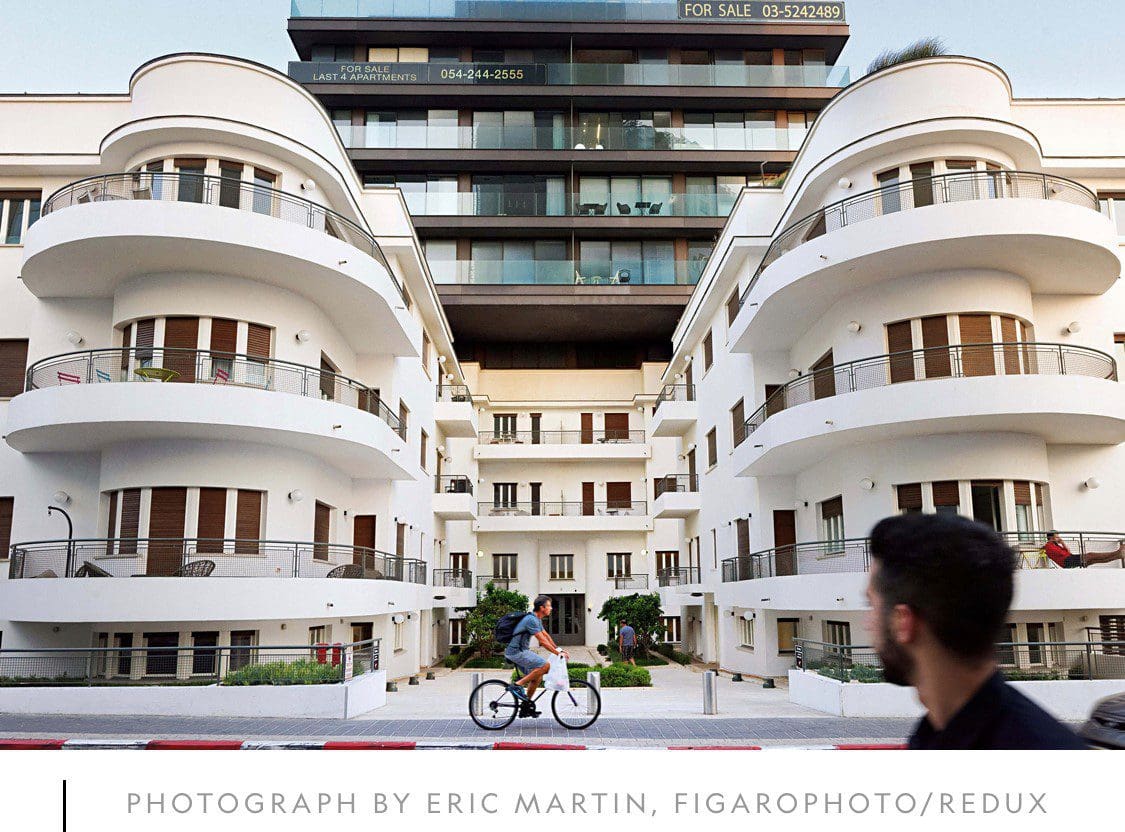
When the Nazi Party took power in 1933, many of the Bauhaus’ leading figures fled the country. They spread the school’s ideas across the globe. One of the largest collections of Bauhaus-style architecture is in Tel Aviv, Israel. The city center is a UNESCO-recognized site thanks to more than 4,000 Bauhaus buildings. German Jews who fled the Nazis in the 1930s designed many. Sharp-eyed observers might spot key differences in Tel Aviv. Here, the ample glass characteristic of Bauhaus structures in Germany is replaced by smaller windows to keep out the hot Mediterranean sun. Weekly walking tours start from the Bauhaus Center, a gallery and museum dedicated to the modernist “White City,” as Tel Aviv is nicknamed. Or rent an audio guide and show yourself the sites. (The Israeli city is home to the biggest cluster of 1930s Bauhaus architecture.)
Chicago
Bauhaus disciple, Laszlo Moholy-Nagy, emigrated to the United States, settling in Chicago . Here he founded the “New Bauhaus” school there in 1937. Then 1938, architect Ludwig Mies van der Rohe followed. The school (now part of the Illinois Institute of Technology) helped turn Chicago into a hub of modernist architecture and design, epitomized by van der Rohe’s maxim “less is more.” Many of the buildings designed by van der Rohe—including the iconic Farnsworth House in nearby Plano, Illinois—are open to visitors.
While sometimes considered cold and impersonal, Bauhaus may not be to everyone’s taste. But a century after its founding, there’s no doubt that, when it comes to modern design, Gropius’ little school in the middle of Germany has had an outsized impact.